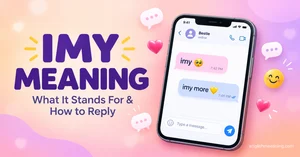
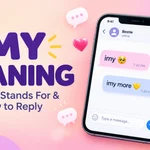
A message lands on your phone. No greeting, no punctuation, just three lowercase letters: IMY. Is it a typo? A brand? Did someone’s cat walk across the keyboard?
IMY stands for “I miss you.” It’s a casual, affectionate shorthand used between friends, family, and partners. Depending on who sends it and how, it can be sweet, playful, or a little flirty. It is not formal, so keep it out of work emails.
What does IMY mean?
IMY is a text abbreviation for “I miss you.” People type it when they want to say they’re thinking of someone without writing out the full sentence. It’s quick, warm, and low-pressure.
A typical use looks like this:
“just saw our old group photo, IMY guys 🥺”
Nobody is asking for anything here. It’s a small signal that says you crossed my mind.
In short: IMY = I miss you = “I’m thinking of you and wish we were together.”
A note on origin: like most text shorthand, IMY grew out of early SMS and chat habits, when every character counted, and spread further through messaging apps and social media. There’s no documented “first use,” so be wary of any site that gives you an exact date or inventor.
Other meanings: “IMY” is also used as a first name or nickname, so context matters. If someone is being addressed directly (“Hey IMY!”), it’s a name. If it appears alone or at the end of a sentence, it almost always means “I miss you.”
Where you’ll see IMY
IMY lives in casual, personal spaces:
- 💬 Private texts and WhatsApp chats, its most common home, especially between close friends, couples, and family
- 👻 Snapchat, often attached to a selfie or a quick “thinking of you” snap
- 📸 Instagram DMs and story replies, especially on throwback photos
- 🎵 TikTok comments, usually under videos featuring friends, couples, or nostalgic clips
- 🎮 Gaming chats, when a regular teammate has gone quiet
It’s a social, informal abbreviation. You won’t see it in professional writing, and shouldn’t use it there.
IMY in real conversations
Here’s how it plays out in practice. Notice how much the meaning shifts with the relationship and the emoji.
Friends catching up
A: it’s been like a month 😭
B: I know!! IMY, let’s actually plan something
Long-distance couple
A: heading to bed
B: night, IMY already 🥺
Parent and child
A: [photo of the dog] he keeps waiting by the door for you
B: aww IMY both ❤️
Flirty
A: haven’t seen you all week
B: IMY 👀 you free friday?
Replying to IMY
A: IMY 🥹
B: IMY more!! Call you tonight?
An awkward one
A: [someone you met once] IMY!!
B: …um, hi? 😅
That last example is real-world etiquette: IMY assumes closeness. From someone you barely know, it can feel like a lot.
Tone: does capitalization and emoji change the meaning?
Yes, noticeably. There are no strict rules, but these patterns are common:
| Style | Typical feel |
| IMY (lowercase) | Relaxed, casual, everyday |
| IMY (caps) | More emphatic, sometimes dramatic or excited |
| IMY 🥺 / 🥹 | Soft, sentimental |
| IMY ❤️ | Affectionate, often romantic or family |
| IMY 👀 / 😏 | Flirty or teasing |
| IMY lol | Light, joking, low stakes |
If you’re unsure how a message was meant, look at the emoji and the history between you and the sender before reading too much into it.
When IMY works, and when it doesn’t
It fits when you’re texting someone you’re close to, reacting to a memory, ending a goodnight message warmly, or reaching out after a long gap.
Skip it when you’re writing to a boss, client, or teacher, handling a serious conversation, or messaging someone you hardly know. It’s also not the best choice when you need to be unmistakably clear, such as in urgent or sensitive situations.
If you’re looking for a more polished equivalent:
| Setting | What to write instead |
| Close friend | “IMY, let’s catch up soon 😄” |
| Partner | “I miss you tonight ❤️” |
| Colleague | “It’s been a while. Hope you’re doing well.” |
| Formal email | “It was great working with you, and I hope we can reconnect soon.” |
| Abbreviation | Meaning | Best for |
| IMU | I miss u | The same idea, slightly more casual; used interchangeably |
| IMYSM | I miss you so much | When the feeling is stronger |
| ILY | I love you | Closer relationships; this is a bigger statement than IMY |
| ILYSM | I love you so much | Deep affection with partners, family, or best friends |
| WYD | What are you doing? | A natural follow-up after saying you miss someone |
Similar abbreviationsIf you want something gentler than IMY, a plain “thinking of you” does the job without any abbreviation.
FAQs
What does IMY mean in a text?
It means “I miss you.” The sender is saying they’re thinking about you and would like to see or hear from you.
Is IMY flirty?
Sometimes. Between friends and family it’s usually warm and platonic. Between crushes or partners, especially with emojis like 👀 or 😏, it can be flirty.
How do I reply to IMY?
Match their energy. “IMY too,” “IMY more,” or “miss you! Call me later?” all work. If you’re unsure how you feel, “aww, thinking of you too” is a safe reply.
Is IMY the same as IMU?
Yes, both mean “I miss you.” The “Y” stands for “you” and the “U” for the shortened “u.”
Can I use IMY at work?
It’s best to avoid it. Use a full sentence such as “It’s been a while, hope you’re well.”
Does IMY mean someone likes me?
Not necessarily. It means they miss you, which could be friendship, family affection, or romance. The relationship and the surrounding conversation tell you more than the three letters do.
Final thoughts
IMY means “I miss you,” and it’s one of the warmest bits of everyday text slang. A few things are worth remembering:
- It’s informal and personal. Use it with people you’re close to.
- Tone comes from context. Emojis, capitalization, and your relationship decide if it’s sweet, flirty, or just friendly.
- A reply doesn’t need to be clever. “IMY too” is plenty.

Liam Carter is an expert in Internet slang, online emotions, and reactions. He decodes chat abbreviations, emojis, and social media expressions, helping readers understand trending online communication clearly at EnglishMeeaning.com.